
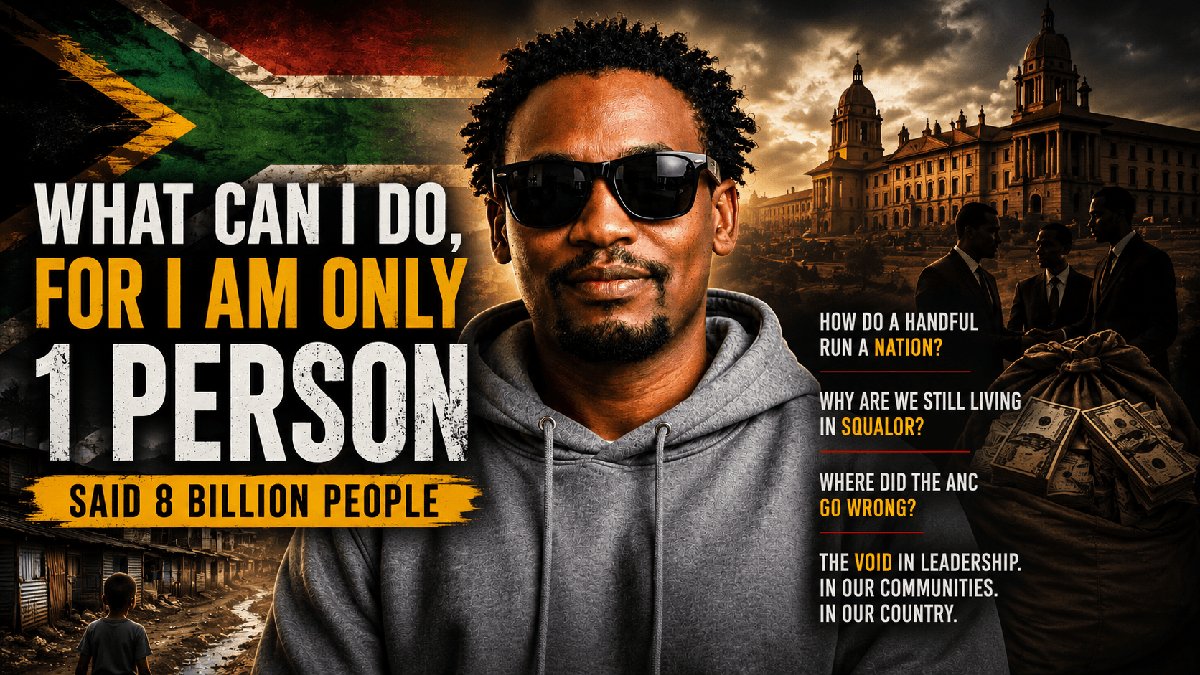
One Person in a World of Eight Billion: The Lie That Power Belongs to Other People
"What can I do? I am only one person," said eight billion people. On power, citizenship, the ANC, township leadership and the lie that responsibility belongs somewhere else.
Systems
One Person in a World of Eight Billion: The Lie That Power Belongs to Other People
By MoAfrika Skotch Ntilane, 14 August 2026
"What can I do? I am only one person," said eight billion people.
There may be no sentence more dangerous in the modern world.
It sounds humble. Realistic, even.
What can one person do against a government? Against corruption? Against billionaires? Against poverty? Against an economy designed by people with more money, more connections, more education, more influence and better access to power?
What can one person do when the township is drowning in unemployment, the municipality is collapsing, the school is failing, the clinic has no medicine, the police arrive after the crime has already happened, and politicians only seem to remember ordinary people when election posters need faces to stand beside?
So we say it.
What can I do? I am only one person.
Then another person says the same thing.
And another.
And another.
Until an entire country is standing in the middle of its own crisis, waiting for somebody else to become the person who does something.
That is how nations decay.
Not only through corruption.
Not only through theft.
Not only through incompetent governments.
Nations also decay through the quiet withdrawal of ordinary people who have been convinced that power belongs somewhere else.
Somewhere in Parliament.
Somewhere in the Union Buildings.
Somewhere in a boardroom in Sandton.
Somewhere behind the gates of an estate.
Somewhere in the office of a political party.
Somewhere with a person whose title is important enough to make decisions on behalf of everyone else.
And so the greatest lie survives.
That the people who hold power are somehow fundamentally different from the people who surrender it.
They are not.
They are simply people who understood, or discovered, that if you do not participate in the organisation of society, somebody else will organise it for you.
And once they have organised it, they may organise it in their own interests.
The Strange Mathematics of Power
South Africa has approximately 63 million people.
The country is governed by a relatively small number of people.
Cabinet ministers. Members of Parliament. Provincial governments. Municipal councils. Mayors. Municipal managers. Directors-general. Boards. Executives. Senior officials. Political party leadership structures.
A few thousand people, directly or indirectly, make decisions that affect the lives of tens of millions.
They decide where money goes. Which roads are repaired. Which schools are built. Which companies receive contracts. Who receives tenders. Who gets appointed. What laws are passed. How land is managed. How infrastructure is maintained. What happens to public money. Whether consequences exist for failure.
And the uncomfortable question is this:
How did the rest of us agree to become spectators in a country that belongs to us?
We often speak about government as if it were a separate species.
"Government must fix this." "They must create jobs." "They must deal with crime." "They must clean the township." "They must stop corruption." "They must build houses."
But who exactly is they?
Government is not a mysterious building that wakes up in the morning and makes decisions by itself.
Government is people.
Ordinary human beings. Some competent. Some incompetent. Some patriotic. Some corrupt. Some intelligent. Some completely unqualified for the positions they occupy. Some committed to public service. Some committed to personal enrichment.
And yet millions of South Africans, many of whom can clearly see the incompetence, corruption and failure, continue to believe that those same people are the only ones capable of deciding the country's future.
This is the paradox.
We complain about leaders as if leadership is a profession reserved for a chosen few.
It is not.
Leadership is simply responsibility accepted where responsibility has been abandoned.
And wherever good people refuse to accept responsibility, somebody else will.
Sometimes that somebody is brilliant. Sometimes they are dangerous. Sometimes they are merely the person who arrived first.
South Africa Is Rich. So Why Are So Many South Africans Poor?
This is where the conversation becomes painful.
South Africa is one of the most naturally endowed countries on Earth.
Gold. Platinum. Coal. Manganese. Chrome. Vanadium. Diamonds. Iron ore. Rare minerals that feed global industries. A sophisticated financial sector. World-class universities. Major ports. A substantial agricultural industry. Tourism potential. Entrepreneurs. Scientists. Artists. Engineers. Young people with extraordinary ability.
And yet millions of people live in informal settlements.
Children walk to schools with broken infrastructure. Families survive on social grants. Young people spend years applying for jobs that do not exist. Graduates sit at home with qualifications and no opportunities. Townships that should have become thriving economic centres remain largely dependent on money flowing in from elsewhere.
And in the most brutal contradiction of all, people live in poverty on land whose wealth has helped build fortunes across the world.
South Africa did not become poor because there was nothing here.
That would almost be easier to understand.
We became trapped because wealth and prosperity are not the same thing.
A country can be rich while its people remain poor.
A nation can extract billions from the ground while communities above that ground have no proper sanitation. A mining company can generate extraordinary value while the nearest township struggles with unemployment. A government can collect enormous amounts of revenue while citizens receive collapsing services.
Natural resources do not automatically produce justice.
They produce opportunity.
What happens to that opportunity depends on who controls the institutions. Who writes the rules. Who benefits from the contracts. Who owns the businesses. Who is educated. Who has access to capital. Who can influence decisions.
And perhaps most importantly, who is held accountable when things go wrong.
That is where South Africa's tragedy begins.
Because apartheid did not merely create racial separation. It created an economic architecture.
It created unequal access to land, education, capital, infrastructure and opportunity.
When democracy arrived in 1994, political power changed hands.
But changing political power is not the same as rebuilding an entire economic civilisation.
The ANC inherited a country with deep structural inequality, enormous expectations and institutions designed under a system built to serve a minority.
That context matters.
But context is not a permanent excuse.
At some point, a liberation movement must become a governing institution.
And governing requires a completely different discipline.
Liberation Is Not the Same Thing as Leadership
The ANC did something historically extraordinary.
It helped lead the struggle against one of the most brutal systems of institutionalised racial oppression in modern history.
That achievement cannot honestly be erased.
Millions of South Africans who were denied political rights gained citizenship in their own country. The Constitution became one of the most progressive in the world. Basic services expanded to millions. Housing programmes were implemented. Social grants became a lifeline for vulnerable households. Education became accessible to people who had previously been systematically excluded.
South Africa was not handed democracy on a silver platter.
People fought. People died. People were imprisoned. Families were destroyed. Lives were sacrificed.
That history deserves respect.
But history cannot govern a country forever.
The people who liberate a nation are not automatically the people best equipped to manage its economy, maintain its infrastructure, build competent institutions and create conditions for sustainable prosperity.
Those are different skills.
And South Africa made a mistake that many post-liberation societies make.
We confused moral legitimacy with administrative competence.
We assumed that because somebody had fought for freedom, they would automatically know how to manage a municipality. Because somebody had suffered under apartheid, they would automatically know how to run a state-owned enterprise. Because somebody was loyal to the movement, they would automatically know how to manage public finances. Because somebody could mobilise people politically, they would automatically know how to build an efficient institution.
These things are not the same.
A struggle requires courage. Government requires competence.
A struggle requires loyalty. Government requires accountability.
A struggle can survive on sacrifice and ideology. A state survives on systems.
South Africa needed both.
Instead, over time, the lines between the liberation movement and the state became dangerously blurred.
Political loyalty increasingly competed with competence. Appointments became political. Institutions became battlegrounds. Public positions became opportunities for networks. State resources became vulnerable to private interests.
And when people complained, the moral authority of liberation was sometimes used as a shield against the practical failures of government.
But a pothole does not care who liberated the country.
A sewage system does not work because of struggle credentials. A child cannot eat historical achievements. A young graduate cannot pay rent with political nostalgia. And a municipality cannot function on songs from the liberation struggle.
At some point, somebody must know how to do the job.
The Great Betrayal Was Not Only Corruption
Corruption is easy to understand.
A politician steals money. A contractor inflates an invoice. A tender is awarded to a connected person. A public project is deliberately overpriced. Money disappears. The infrastructure is never completed. Everyone is angry. The newspapers write about it. Eventually another scandal replaces the previous one.
But corruption is not the only problem.
Sometimes the greater damage is incompetence protected by politics.
The person who does not steal a cent but cannot do the job can still destroy an institution.
The manager who is loyal but incapable can cause just as much damage as the thief. The official who refuses to make decisions. The municipal department where nobody knows who is responsible. The company that receives a contract because of connections and then fails to deliver. The manager who surrounds themselves with people weaker than themselves because competent people ask uncomfortable questions.
This is how countries slowly become dysfunctional.
Not through one dramatic collapse.
Through thousands of small failures that become normal.
A broken streetlight. A leaking pipe. An unanswered email. A tender delayed. A maintenance budget ignored. A competent employee leaving. An incompetent employee promoted. A whistleblower punished. A corrupt official protected. A community meeting attended by people who already know nothing will change.
Eventually citizens stop expecting institutions to work.
And that is when decline becomes psychological.
Because once people no longer believe that anything can change, they begin to organise their lives around failure.
They buy water tanks because municipal water cannot be trusted. They install solar systems because electricity cannot be trusted. They hire private security because policing cannot be trusted. They send their children to private schools because public education cannot be trusted.
Those who can afford alternatives escape.
Those who cannot remain inside the collapsing system.
And inequality becomes self-reinforcing.
The Township Leadership Crisis Nobody Wants to Talk About
We love talking about national leadership because it is far away.
It is easier to blame Cyril Ramaphosa than to ask why nobody in our street has organised a community meeting in two years. It is easier to complain about Parliament than to ask why our local civic structures are dead. It is easier to curse politicians than to admit that many communities have surrendered every responsibility except complaining.
This is not an attack on poor communities.
It is a challenge to all of us.
Because poverty can destroy more than income.
It can destroy agency.
When generations of people are repeatedly excluded from meaningful economic participation, they can begin to believe that decisions are always made somewhere else.
The government will decide. The councillor will decide. The municipality will decide. The NGO will decide. The rich people will decide. The donor will decide. Somebody will decide.
And so communities become consumers of leadership instead of producers of it.
We wait for a politician to organise the clean-up. We wait for government to create the youth programme. We wait for a sponsor to fund the sports team. We wait for somebody to fix the school. We wait for a businessman to create jobs.
We wait.
And while we wait, young people become older. Buildings deteriorate. Children learn from the behaviour around them. Crime establishes itself as an alternative economy. Drugs fill the vacuum left by opportunity.
And eventually the community begins to look exactly like what happens when responsibility has been outsourced.
The vacuum does not remain empty.
It never does.
If decent people do not lead, criminals will. If organised citizens do not organise communities, political opportunists will. If communities do not build local economies, outside businesses will extract the spending power and take the profits elsewhere. If parents do not become involved in schools, dysfunctional systems will continue without resistance. If skilled people remain silent, unqualified people will speak with confidence.
Nature hates a vacuum.
So does society.
We Have Reduced Citizenship to Voting
Every five years, South Africans become politically alive.
Suddenly everybody has an opinion. We argue on Facebook. We fight on X. We insult political parties. We attend rallies. We analyse election results.
Then the election ends.
And citizenship goes back into hibernation.
We have somehow convinced ourselves that democracy is something we perform at a voting station.
It is not.
Voting is the beginning of citizenship, not the completion of it.
A democracy requires citizens who pay attention between elections. Who attend meetings. Who understand municipal budgets. Who ask where money went. Who challenge poor decisions. Who organise. Who build. Who volunteer. Who start businesses. Who mentor. Who teach. Who report corruption. Who stand for positions of responsibility. Who refuse to clap for incompetence because it comes from their preferred political party.
That last part is particularly important.
South Africa cannot be repaired by citizens who are more loyal to political organisations than they are to the country.
A corrupt politician does not become less corrupt because they wear the colours you support. An incompetent official does not become competent because their struggle history is impressive. A good policy does not become bad because it came from the opposition. A bad policy does not become good because it came from your side.
The country is bigger than the party.
Or at least, it should be.
The Handful of People Running the Country Are Not Superhuman
This is the part that should disturb you.
The people running South Africa are not sitting on a mountain somewhere because they possess knowledge unavailable to the rest of humanity.
They are people. They have advisers. They make mistakes. They forget things. They have biases. They are influenced by the people around them.
Some are brilliant. Some are mediocre. Some are in positions that demand skills they simply do not possess.
And yet millions of people look at them and think: "They must know what they are doing."
Why? Because of a title? Because of a suit? Because they were appointed? Because they appear on television?
History is full of societies being controlled by people who were not necessarily the wisest, smartest or most ethical members of those societies.
Power does not automatically find the best person.
Often, power finds the person most willing to pursue it.
Sometimes that is a good thing. Sometimes it is a disaster.
The real question, therefore, is not whether one person can change the world.
One person already does.
Every position of power is occupied by one person at a time.
The president is one person. A minister is one person. A mayor is one person. A municipal manager is one person. A school principal is one person. A community organiser is one person. A gangster controlling a street is one person. A teacher changing the trajectory of fifty children is one person.
The difference is not that some people are one person and others are many.
The difference is what happens when one person connects their actions to other people.
That is how power works.
One person acts. Another joins. Then another. A structure forms. A movement begins. A business grows. A community organisation develops. A political party emerges. An institution is created.
The most powerful systems in the world began as small groups of people who stopped accepting that they were too small to matter.
The Most Dangerous Phrase in South Africa Might Be "It Is Not My Problem"
A drain is blocked. Not my problem.
Children are hanging around the street during school hours. Not my problem.
A local government official is stealing. Not my problem.
A school governing body is dysfunctional. Not my problem.
A young person needs mentorship. Not my problem.
A neighbour is struggling. Not my problem.
A community hall is falling apart. Not my problem.
Eventually we are all surrounded by problems that belonged to somebody else until they became ours.
Crime does not respect property boundaries. Unemployment does not stay in one household. A failing school affects the entire future economy. Corruption increases the cost of everything. A collapsing municipality eventually affects even those who thought they were insulated from it.
There is no private escape from a public collapse.
You can move to a better suburb. You can build higher walls. You can employ private security. You can install solar power and boreholes.
But you cannot build a prosperous life forever inside a society that is falling apart around you.
Eventually the cost comes home.
It always does.
What If the Problem Is Not That We Have Too Little Power?
Perhaps the problem is that we have misunderstood where power lives.
We think power only exists in money.
Money is power. But it is not the only form.
Knowledge is power. Organisation is power. Trust is power. Reputation is power. Skills are power. Networks are power. Time is power. Technology is power. The ability to communicate is power. The ability to gather ten people around a problem is power. The ability to understand how government works is power. The ability to build something instead of merely criticising what exists is power.
A person with R100 million who cannot organise people has limits.
A person with no money but the ability to organise 10,000 people has a different kind of power.
South Africa has repeatedly underestimated the power of organised communities.
The anti-apartheid struggle itself should have taught us this.
Ordinary people, many with almost nothing, confronted one of the most powerful states on the African continent.
Students. Workers. Church leaders. Parents. Teachers. Lawyers. Writers. Activists. Trade unionists. Ordinary citizens.
They were not powerful individually in the conventional sense.
Together, they became impossible to ignore.
And yet, somehow, after democracy, many of us forgot the lesson.
We started waiting for institutions to do what organised citizens once forced institutions to do.
The ANC Did Not Fail Alone
This is going to make some people uncomfortable.
The ANC must take responsibility for its failures.
There is no honest way around that.
The party has governed South Africa for decades. It cannot forever blame apartheid for failures that developed under its own watch.
State capture happened under ANC governance. Institutional decay happened under ANC governance. Cadre deployment became a serious point of national concern under ANC governance. Municipal failures happened under ANC governance. Corruption scandals multiplied under ANC governance. Unemployment remained catastrophic under ANC governance. Infrastructure deteriorated under ANC governance.
The public deserves accountability.
Full stop.
But the ANC did not fail alone.
We enabled things we should have challenged. We defended people because they belonged to our political side. We accepted mediocrity because we feared strengthening the opposition. We celebrated appointments before asking whether the person could actually do the work. We treated criticism as betrayal. We often preferred slogans to evidence.
And when the damage became undeniable, we discovered that institutions are much harder to rebuild than they are to destroy.
A political party cannot repair South Africa by itself. Neither can a president. Neither can business. Neither can civil society. Neither can churches. Neither can NGOs.
The fantasy that one heroic leader will arrive and save the country is exactly the kind of thinking that keeps citizens passive.
South Africa does not need another messiah.
South Africa needs millions of people who understand that the country is partly their responsibility.
The Void Is Local Before It Becomes National
Before a country has a leadership crisis, it often has a neighbourhood crisis.
Before Parliament becomes dysfunctional, community structures have usually been neglected. Before young people become politically disconnected, they have often grown up seeing leadership as something distant, corrupt or irrelevant.
Look around.
Who are the people organising your community? Who knows the needs of the elderly? Who knows which children are dropping out of school? Who is connecting unemployed young people to opportunities? Who is helping small businesses work together? Who is teaching people digital skills? Who is monitoring local government projects? Who is building local databases of skills, jobs and services? Who is asking what the township needs to produce instead of only asking what it needs to receive?
The answers are often uncomfortable.
Because sometimes there is nobody.
There are people with titles. There are councillors. There are committees. There are church leaders. There are political branches. There are WhatsApp groups full of complaints.
But there is no coordinated vision. No shared data. No measurable plan. No accountability. No continuity.
Every few years, another initiative begins. Photos are taken. Speeches are made. T-shirts are printed. Then the people disappear and the community remains exactly where it was.
This is not leadership.
It is activity without architecture.
South Africa does not merely need more projects.
We have projects everywhere.
We need systems that survive the people who started them.
Stop Asking What Government Can Give Your Township. Ask What Your Township Can Build
This does not mean government must escape its responsibilities.
The state has obligations. Citizens pay taxes. Public officials are employed to serve the public. Municipalities are not doing communities a favour by providing water, sanitation, roads and basic services.
Those are responsibilities.
Demand them. Fight for them legally and politically. Hold officials accountable.
But do not make the mistake of believing that development only begins when government arrives.
That mindset has destroyed initiative.
Townships contain skills that are not connected. Businesses that do not collaborate. People looking for work who do not know what opportunities exist next door. Retired professionals with decades of experience. Young people with digital skills.
Artisans. Drivers. Teachers. Cooks. Designers. Mechanics. Developers. Writers. Entrepreneurs. Farmers. Artists. Care workers. Security professionals. Tradespeople.
What would happen if these people were properly mapped, connected and organised?
What would happen if every township built its own skills database? Its own local procurement network? Its own youth mentorship structure? Its own community business directory? Its own repair and maintenance cooperatives? Its own digital education programmes? Its own local investment clubs? Its own accountability platforms?
We keep looking at the township through the eyes of consumption.
Where can people shop? Where can they get grants? Where can they find jobs? Where can government provide something?
Those questions matter.
But there is another question.
What can this community produce that the world is willing to pay for?
That question changes everything.
Because poverty is not only the absence of money.
It is often the absence of access to systems through which human value can become economic value.
South Africa has people with ability sitting in communities that have no mechanism to turn that ability into income.
The result is tragic.
A talented person becomes unemployed. An unemployed person becomes discouraged. Discouragement becomes identity. Identity becomes inherited.
Then a child grows up believing that unemployment is normal because almost everyone around them is unemployed.
This is how poverty reproduces itself.
Not only through a lack of money.
Through a lack of imagination connected to infrastructure.
One Person Is Not Enough
Let us be honest.
One person cannot fix South Africa.
You cannot personally repair Eskom. You cannot personally rebuild every municipality. You cannot personally eliminate corruption. You cannot personally employ millions of unemployed people.
Anyone telling you that individual effort alone can solve structural problems is selling a motivational fantasy.
But that is not the point.
One person does not have to do everything.
One person has to do something real. Something specific. Something measurable. Something that connects to other people.
The obsession with changing the entire world often prevents people from changing the piece of the world directly in front of them.
You do not need to solve youth unemployment. Can you help ten young people access opportunities?
You do not need to fix education nationally. Can you teach twenty people a useful skill?
You do not need to end township poverty. Can you create one functioning economic network?
You do not need to rebuild the municipality. Can you organise residents around one specific issue and refuse to disappear until it is addressed?
The country changes when responsibility becomes contagious.
When one person refuses to walk past a problem and instead gathers five others. Those five gather ten more. The work becomes organised. The organisation becomes an institution. The institution develops influence. Influence changes decisions.
That is how countries are actually changed.
Not by people waiting to become powerful enough to begin.
By people beginning with the power they already have.
The Question We Should Be Asking
Perhaps the question was always wrong.
"What can I do? I am only one person among eight billion."
No.
The better question is:
What happens if eight billion people each decide they are only one person and therefore somebody else must act?
That is the world we have built.
A world where responsibility is passed upwards until it reaches people who are often no more qualified than the people who surrendered responsibility to them.
And perhaps that is the haunting truth.
The people we complain about did not arrive from another planet. They came from our communities. They went to our schools. They learned our habits. They absorbed our political culture. They discovered what we reward and what we tolerate.
If we want different leaders, we have to create a society that rewards different behaviour.
A society where competence matters. Where integrity matters. Where public service is not a route to personal enrichment. Where criticism is not treated as betrayal. Where young people are prepared for leadership before they enter positions of power. Where community involvement is normal. Where citizens understand budgets. Where corruption is socially unacceptable even when the corrupt person is a friend, relative or political ally. Where the person who can do the job is allowed to do the job.
South Africa will not be saved by louder speeches. We have had enough speeches.
It will not be saved by more slogans. We have enough slogans to wallpaper every informal settlement in the country.
It will not be saved by another election alone. Elections matter, but voting without active citizenship is simply changing the driver while ignoring the condition of the vehicle.
The country will begin to change when ordinary people stop describing themselves as ordinary.
There is nothing ordinary about a person who decides to take responsibility.
The Brutal Truth
The brutal truth is that many of us have become comfortable with helplessness.
We know the country is failing in places. We know who is stealing. We know which municipality is dysfunctional. We know which young people are struggling. We know which children are hungry. We know which opportunities never reach the people who need them.
We know.
But knowledge without action can become another form of cowardice.
We share the article. We write the Facebook post. We argue in the comments. We curse the politicians. Then we go to sleep believing we have participated.
We have become a country of spectators with strong opinions about the match.
Everybody has an analysis. Very few people are building the team.
And that is why the phrase "I am only one person" must be challenged.
Yes, you are one person.
So is the person who steals billions. So is the person who signs the contract. So is the person who approves the appointment. So is the person who starts the company. So is the teacher who changes a child's life. So is the community member who organises the meeting. So is the young person who builds the platform. So is the whistleblower. So is the entrepreneur who employs three people, then ten, then fifty.
Every human achievement begins with somebody who was, at the beginning, only one person.
The difference is that they did not stay isolated.
They turned intention into action. Action into organisation. Organisation into power. And power into change.
That is the formula.
Not magic. Not destiny. Not waiting for the right politician. Not waiting for a billionaire to rescue the township. Not waiting for government to become competent overnight. Not waiting for somebody else.
Start where you are. Look at the problem closest to you. Ask what resources already exist. Ask who else cares. Bring people together. Build something small enough to begin and serious enough to matter.
Then protect it from the disease that destroys so many good South African initiatives.
Ego. Politics. Poor governance. Lack of accountability. Dependency on one personality. No systems. No succession plan. No measurement.
Build institutions, not personalities. Build systems, not posters. Build capacity, not dependency. Build communities that can continue working after the founder leaves.
Because that is what a functioning country is.
Not a collection of powerful politicians.
A network of functioning institutions supported by citizens who refuse to surrender their responsibility.
The Day Eight Billion People Stop Saying "I Am Only One"
South Africa does not need all 63 million people to become politicians.
God forbid. We have enough.
We need people to become responsible where they are.
A teacher who takes education seriously. A business owner who pays people fairly and trains young workers. A developer who builds tools for problems nobody else is solving. A church that understands that salvation without social responsibility leaves communities unchanged. A parent who refuses to pass helplessness down to their children. A community leader who does not need a tender to serve. A young person who stops waiting for permission to begin. A professional who gives a few hours each month to mentor somebody. A resident who knows what is happening with their municipal budget. A citizen who can say to their own political party, "No. This is wrong."
That is where the recovery begins.
Quietly. Locally. Without cameras. Without speeches. Without waiting for permission.
Because perhaps the greatest theft in human history was not the theft of land, minerals, money or political power.
Perhaps it was the theft of ordinary people's belief that they are capable of shaping the world around them.
And once that belief is stolen, everything else becomes easier to steal.
Your labour. Your resources. Your future. Your vote. Your children's opportunities. Your hope.
So when you find yourself saying, "What can I do? I am only one person," remember this.
Every corrupt official is one person. Every president is one person. Every revolutionary was one person before others joined them. Every institution began with people who did not exist as an institution yet. Every movement began before it became a movement. Every community that changed began with somebody who finally became tired of watching.
You are one person.
That is not an excuse.
That is where everything begins.
The real danger is not that you are only one person in a world of billions.
The real danger is that billions of people are saying exactly the same thing, at the same time, while a handful of people decide what happens to all of us.
And perhaps that handful is not powerful because they are extraordinary.
Perhaps they are powerful because the rest of us have spent too long believing that we are not.
"What can I do? I am only one person," said eight billion people. And somewhere, a handful of people smiled.
Leave a reflection
How did this land?
Share this piece
Idea trail
If this resonated, read these next
The Slow Letter
No content calendar.
No Tuesday motivation. No nonsense.
Just the occasional letter when I have something worth interrupting your inbox for. I don't know when the next one is coming. That's kind of the point.