
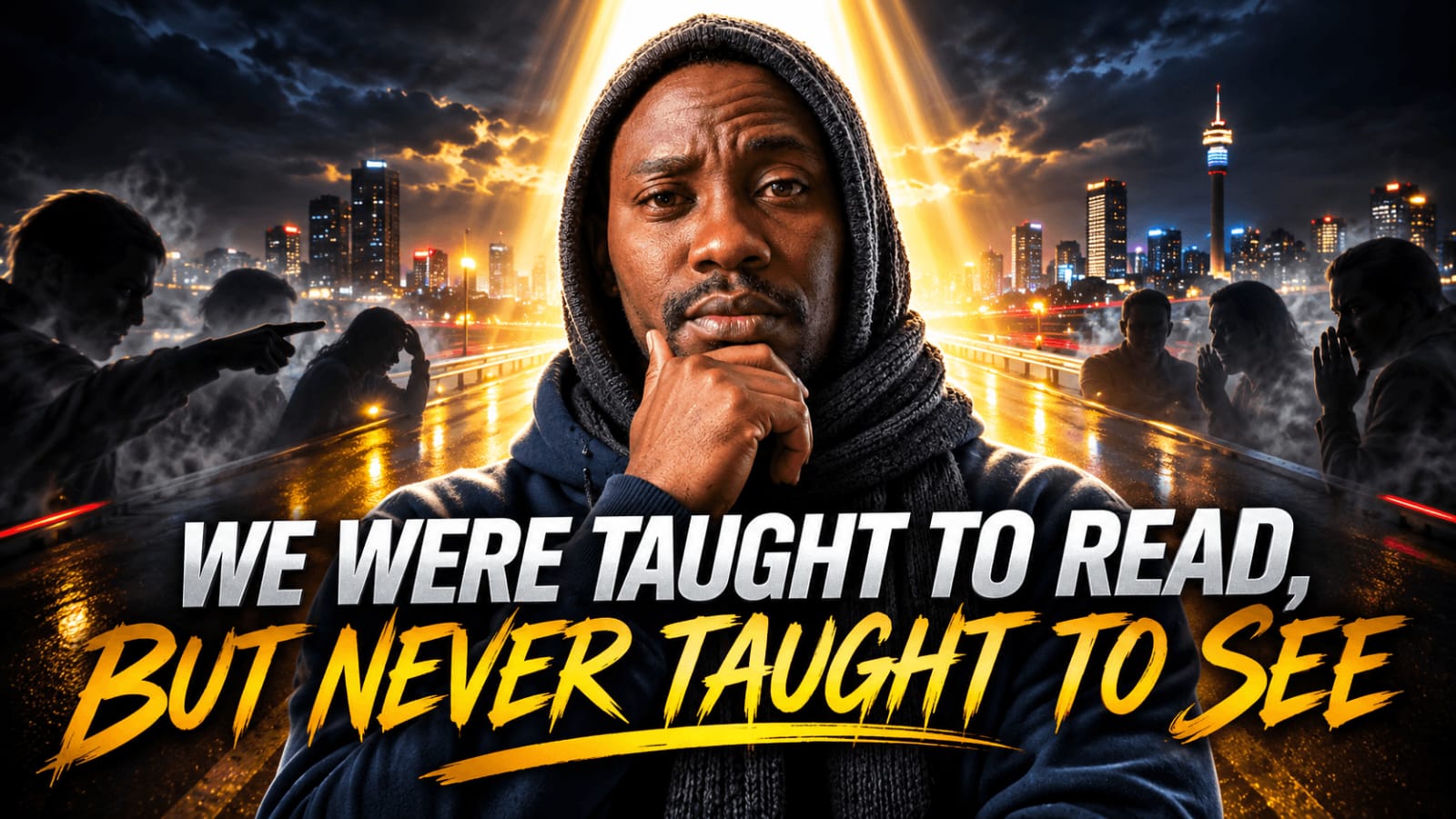
We Were Taught to Read, But Never Taught to See
The tragedy of an educated nation that has mastered the language of progress while slowly forgetting the meaning of humanity.
An exploration of intelligence without wisdom, the inheritance of oppression, the education of contempt, and the spiritual blindness of a society that knows almost everything except how to love its own people.
THE MOST DANGEROUS KIND OF BLINDNESS
Somewhere in South Africa this morning, a child woke up before sunrise, washed in a plastic basin, dressed in a school uniform that has survived more winters than it was ever manufactured to endure, and stepped into a world that had already decided how much of their humanity it was prepared to recognise.
That child walked past houses surrounded by electric fences, past rubbish that the municipality had forgotten, past unemployed men who once believed their matric certificates were passports to a different existence. They probably passed a church, a tavern, a spaza shop and a political poster promising a better tomorrow with the confidence of somebody who has never had to explain yesterday.
Eventually, that child arrived at school.
There, beneath a leaking roof or perhaps inside a beautiful classroom, depending on the accident of geography and the financial circumstances of their parents, they would be taught mathematics, history, science and language. They would learn how to calculate the circumference of a circle, identify the organs of the human body and explain the economic activities that contribute to the country's gross domestic product.
They might even learn the meaning of democracy.
But who would teach them to recognise the humanity of the unemployed man they passed on their way to school?
Who would explain why the woman cleaning the toilets in a wealthy household works harder than many of the people whose salaries exceed hers by an amount she cannot imagine?
Who would teach them that the person selling tomatoes beside a taxi rank is not necessarily a failed human being, but possibly an extraordinary human being surviving the failures of an entire economic arrangement?
And, perhaps most importantly, who would teach them that intelligence without compassion can become one of the most sophisticated instruments of cruelty ever invented?
We have become remarkably good at producing people who know things.
We have been considerably less successful at producing people who understand things.
And somewhere between those two conditions, the soul of South Africa has been quietly bleeding.
There is a particular kind of tragedy in a country where almost everybody knows what oppression looks like, yet so many people continue to reproduce its methods in their homes, workplaces, churches, schools, relationships and communities.
We recognise injustice when it is committed against us.
We become strangely philosophical when we are the ones committing it.
We understand humiliation perfectly when we are its victims.
We suddenly call it discipline, tradition, professionalism or personal preference when we are its authors.
Perhaps that is the most frightening possibility of all.
That ignorance is not always the absence of education.
Sometimes ignorance is precisely what our education has taught us to defend.
1. WE HAVE INTELLIGENCE, BUT HAVE WE ACQUIRED WISDOM?
Intelligence and wisdom have been treated as interchangeable concepts for so long that we have almost forgotten how profoundly different they are.
Intelligence can help a person construct a magnificent building. Wisdom asks whether the people who built it can afford to live anywhere near it.
Intelligence can produce an economic policy sophisticated enough to impress international investors. Wisdom asks whether the grandmother selling vegetables at the intersection will experience any meaningful improvement in her life.
Intelligence can win an argument.
Wisdom knows when winning an argument will cost us something more valuable than being right.
A person can possess three university degrees and still be incapable of apologising to a child.
A person can quote philosophers, explain international relations and deliver extraordinary speeches about human rights while treating the domestic worker in their home as though dignity were a privilege reserved for those who occupy a particular income bracket.
A person can understand the chemical processes responsible for human tears without ever developing the emotional intelligence to recognise when they have caused them.
This is not an argument against education.
It is an argument against our dangerous tendency to confuse education with moral achievement.
A qualification is evidence that somebody has satisfied the requirements of a particular field of study. It is not a certificate of kindness, justice, humility or emotional maturity.
We have allowed educational achievement to become a convenient substitute for character.
We respect vocabulary more readily than integrity.
We mistake confidence for competence, wealth for wisdom, and eloquence for truth.
Sometimes the person who understands the human condition most profoundly has never entered a university lecture hall.
Sometimes that person is a grandmother who survived forced removals, buried children, raised grandchildren and still possesses enough tenderness to feed a stranger.
She may struggle to explain the philosophical foundations of ethics.
But she has spent her entire life practising them.
And perhaps there is something deeply wrong with a society that considers her uneducated while celebrating people who can explain justice academically but cannot recognise it when it is standing hungry outside their gates.
The tragedy is not that we have learnt too much.
It is that we have learnt so much without learning what knowledge is supposed to be for.
2. A COUNTRY EDUCATED TO SEPARATE ITSELF
South Africa understands the relationship between education and division better than many nations should ever have to.
Under apartheid, education was deliberately structured around racial inequality.
The Bantu Education Act of 1953 did not merely introduce another administrative arrangement. It formed part of a political project designed to restrict the opportunities available to black South Africans and prepare them for subordinate positions within an economy controlled by others.
The classroom became an instrument through which the state attempted to manufacture the future.
Children were not simply being taught different subjects.
They were being taught different expectations of themselves.
One child's future was imagined in terms of ownership, authority and possibility.
Another child's future was organised around service, obedience and limitation.
An entire system worked to make inequality appear natural, as though the circumstances into which children were born revealed something about their inherent value.
Apartheid understood something terribly important.
If you can influence what children believe about themselves, you do not always have to physically restrain the adults they become.
Some will carry the boundaries inside their own minds.
Others will grow up believing those boundaries are justified.
This is how an oppressive system tries to extend itself beyond the lifetime of its laws.
It builds itself into language, memory, aspiration and social behaviour.
It teaches people where they supposedly belong.
And even after the legislation has been dismantled, the habits it cultivated can survive.
Consider how casually South Africans still classify one another.
We measure people by their accents, surnames, complexions, neighbourhoods, schools and clothing.
We attach assumptions to languages.
We use addresses as evidence of character.
We confuse proximity to wealth with proximity to excellence.
A person introduces themselves and, before they have completed the sentence, somebody else has already begun calculating where to place them in the invisible hierarchy of human worth.
We have become exceptionally skilled at reading status.
Yet we remain dangerously poor at reading suffering.
And that is why the end of a political system does not automatically signal the end of the thinking that sustained it.
A country can dismantle the laws of oppression while leaving its psychology almost completely intact.
3. THE DEMOCRACY THAT ARRIVED BEFORE EQUALITY
In 1994, South Africa entered a new democratic era carrying extraordinary hope.
The franchise was transformed. A constitutional order founded on dignity, equality and freedom replaced the formal system of apartheid.
But political freedom arrived in a country where wealth, infrastructure, land, opportunity and accumulated advantage had been distributed through generations of racial exclusion.
The ballot could change the government.
It could not, by itself, immediately change the balance in a family's bank account.
It could not instantly move a child from an overcrowded classroom into a well-resourced school.
It could not restore every inheritance that dispossession had interrupted.
And it could not remove the psychological damage caused by generations of being told, directly or indirectly, that certain lives mattered less.
Today, two children can be born within a relatively short distance of one another and inherit radically different versions of the same South Africa.
One may grow up surrounded by books, reliable internet, private medical care, extracurricular activities and adults who can finance a second attempt when the first plan fails.
The other may grow up in a household where the loss of a single income threatens the next meal.
One experiences mistakes as lessons.
The other experiences mistakes as potential disasters.
One is encouraged to explore their interests.
The other is reminded, often without anyone saying it aloud, that survival must come before curiosity.
Both are told to work hard.
Both are told that education is the key to success.
But nobody explains why one child begins the race holding a key while the other is still searching for a door.
And when the second child struggles, society often responds with a lecture about personal responsibility.
Of course, personal responsibility matters.
Discipline matters. Choices matter. Effort matters.
But pretending that structural inequality disappears because individual effort exists is not wisdom.
It is intellectual dishonesty.
We cannot seriously discuss success without discussing the conditions under which success becomes possible.
Nor can we discuss failure without acknowledging how differently its consequences are distributed.
In a prosperous household, failure may be an inconvenience.
In a desperately poor household, failure can interrupt an entire generation's hopes.
We must resist turning poverty into a moral diagnosis.
Because a poor person is not necessarily somebody who has made poor decisions.
Sometimes they are somebody whose entire life has been spent surviving decisions made long before they were born.
4. THE EDUCATION OF CONTEMPT
There is another curriculum operating in South Africa.
It is rarely printed in textbooks.
It has no formal examination and does not appear on a school timetable.
Yet millions of people are exposed to it every day.
It is the education of contempt.
We learn to laugh at broken English.
We learn to associate poverty with laziness.
We learn to dismiss people because of where they live.
We learn to regard certain jobs as humiliating, although we depend on the people performing them.
We learn that a person's worth can be estimated through the value of their possessions.
And eventually, we become so accustomed to these judgements that we mistake them for common sense.
Listen carefully to the language used when somebody becomes successful.
People say they have made it out of the township.
They have escaped the village.
They have risen above their background.
There is nothing inherently wrong with celebrating improved circumstances or leaving an environment that limits opportunity.
But notice how easily the language of progress can transform the places and people who raised us into symbols of shame.
A person acquires money and suddenly their mother's accent becomes embarrassing.
Their childhood friends become liabilities.
Their relatives become burdens.
Their community becomes something they describe apologetically to strangers.
Success begins to resemble a carefully managed disappearance.
And the person who once prayed for the opportunity to rise above their circumstances now behaves as though those circumstances were evidence of an inferior human identity.
What exactly have they escaped?
Poverty?
Or the responsibility of remembering the humanity of people who remain poor?
There is a difference between outgrowing a circumstance and developing contempt for those who still inhabit it.
The first can be progress.
The second is moral regression dressed in expensive clothing.
We should never confuse leaving a place with becoming better than its people.
And we should be deeply suspicious of any definition of success that requires somebody to become ashamed of the hands that raised them.
Perhaps one of the most tragic things about oppression is that its victims do not always discard its values when they finally acquire power.
Sometimes they inherit its vocabulary.
Sometimes they reproduce its hierarchies.
Sometimes they become so determined never to be humiliated again that they begin humiliating others.
They confuse power with healing.
They confuse superiority with recovery.
They spend the rest of their lives attempting to become the very people whose cruelty once wounded them.
And the cycle continues, except the uniforms have changed.
5. WHEN POVERTY BECOMES AN ACCUSATION
Poverty is not only the absence of money.
It can become a sustained assault on a person's sense of possibility.
It is the humiliation of having to explain why you cannot contribute to a family gathering.
It is the anxiety of watching an electricity meter approach zero while the month still has too many days remaining.
It is the silence after somebody asks what you do for a living.
It is the careful calculation required before accepting an invitation to something as ordinary as lunch.
It is the emotional exhaustion of constantly proving that your needs are legitimate.
And perhaps most painfully, it is the experience of having your character evaluated by people who have never had to survive your circumstances.
Poverty teaches a person many things that a classroom does not.
It teaches arithmetic through necessity.
It teaches negotiation through desperation.
It teaches patience through exclusion.
It teaches resilience, although we should be careful not to romanticise suffering simply because some people survive it with extraordinary strength.
Nobody should have to become heroic merely to eat.
Nobody should have to demonstrate exceptional character to deserve basic dignity.
There is something obscene about a society that praises the resilience of poor people while remaining insufficiently disturbed by the conditions that demand it.
We celebrate the child who studies under a streetlight.
We share the photograph.
We applaud the determination.
We call the story inspirational.
But why is the child studying under a streetlight in the first place?
Why has electricity, something so ordinary in the lives of the comfortable, become the dramatic centrepiece of another child's struggle?
What happens when our admiration for individual perseverance becomes an excuse not to confront collective failure?
An educated society should be able to hold two truths together.
We can admire resilience.
And we can condemn the injustice that makes extraordinary resilience necessary for ordinary survival.
The child deserves recognition for their determination.
But they also deserve electricity.
And the fact that we sometimes struggle to distinguish between those two obligations reveals the limitations of our moral education.
There are people in this country who have spent their entire lives solving problems that money would have prevented.
They have developed extraordinary intelligence around scarcity.
They can stretch a small amount of money across a week, feed several children from almost nothing, negotiate with creditors, improvise household repairs and manage emergencies with a level of creativity that would embarrass entire corporate strategy departments.
Yet when they enter certain rooms, their intelligence becomes invisible because it has not been formally certified.
We call them unskilled.
We call them disadvantaged.
We call them beneficiaries.
Rarely do we call them what many of them actually are.
Experts in surviving a society that has made ordinary life unnecessarily difficult.
The danger, of course, is turning this survival intelligence into another romantic story.
Their resourcefulness deserves admiration.
Their suffering does not deserve preservation.
A country that constantly celebrates its people's ability to survive should eventually develop the courage to ask why so much of their intelligence is being consumed by survival.
6. WE HAVE LEARNT TO ENVY WHAT WE SHOULD BE BUILDING
There is a particular kind of jealousy that grows in environments where opportunity feels permanently scarce.
Somebody starts a business and, instead of asking how the enterprise might create opportunities, people begin investigating why its founder deserves to fail.
Somebody returns to school as an adult and is mocked for attempting something others abandoned.
Somebody buys a car and the neighbourhood becomes a courtroom.
Somebody improves their circumstances and suddenly every achievement requires a suspicious explanation.
This behaviour is often dismissed as ordinary jealousy.
But jealousy can have deeper roots.
When people are repeatedly exposed to exclusion, another person's progress can begin to feel like evidence of their own stagnation.
Success becomes painful to witness because it reminds the observer of dreams they have been forced to postpone.
The problem is not always that people hate achievement.
Sometimes achievement has become a mirror reflecting everything they fear they will never experience.
This does not justify cruelty.
It helps us understand why cruelty can become socially contagious.
A community that has been denied opportunities for generations may develop habits of competition even where cooperation would create more value.
Instead of building a ladder, people fight over the person who has climbed one.
Instead of demanding a bigger table, they argue about who deserves the last available chair.
And because everyone is exhausted, everyone begins to mistake survival for victory.
Yet another person's success does not automatically diminish our own possibilities.
A neighbour's business can become a source of employment.
A friend's qualification can become a source of knowledge.
A young person's breakthrough can become evidence that a different future is imaginable.
But this requires something more difficult than applause.
It requires us to develop the ability to celebrate progress without making ourselves the centre of somebody else's achievement.
Envy asks, "Why them?"
Wisdom asks, "What can we learn, and what can we build together?"
One question reproduces resentment.
The other makes room for possibility.
South Africa desperately needs more of the second.
Imagine what could happen if communities became as interested in developing one another's talents as they sometimes are in investigating one another's shortcomings.
Imagine if the person who understands business taught the person who understands farming, and both learnt from the person who understands technology.
Imagine if established professionals treated mentorship as part of their responsibility rather than an occasional act of charity.
Imagine if success were measured not only by how far an individual had travelled, but by how many opportunities had become possible because they travelled at all.
This would not eliminate inequality overnight.
It would not absolve government or institutions of their responsibilities.
But it would begin to challenge the emotional habits through which inequality reproduces itself.
We cannot build a society capable of collective progress while continuing to experience every individual breakthrough as a personal insult.
7. WE ARE CONNECTED TO EVERYTHING EXCEPT ONE ANOTHER
Technology has given us unprecedented access to information.
A young person in a township can learn programming, study philosophy, develop a business plan, access university lectures and communicate with people across the world using a device small enough to fit inside a pocket.
That is an extraordinary development.
But access to information has not automatically produced emotional maturity.
We now live in a society where people can publicly discuss mental health while privately humiliating somebody experiencing emotional distress.
We circulate motivational quotations about kindness while participating in the destruction of another person's reputation.
We condemn bullying in schools and then transform social media comment sections into public arenas of punishment.
We speak passionately about justice until accountability becomes personally inconvenient.
There is something uniquely disturbing about watching an educated person use sophisticated language to justify behaviour that would embarrass a child who has simply learnt to be kind.
The internet has amplified our capacity to perform intelligence.
It has not necessarily strengthened our capacity for reflection.
We have begun to mistake being informed for being thoughtful.
We confuse having an opinion with understanding a problem.
We interpret disagreement as disrespect.
And increasingly, we reward the person who delivers the cruelest response with the greatest confidence.
A devastating insult can receive thousands of reactions.
A careful explanation may barely be noticed.
Humiliation has become entertainment.
Outrage has become a business model.
And the suffering of real human beings is routinely converted into content for people who will forget the victims before the next notification arrives.
Consider what happens when someone makes a mistake in public.
Thousands of strangers may dissect their appearance, education, family circumstances and personal history.
The original wrongdoing becomes secondary.
The opportunity to humiliate becomes the main event.
We call this accountability.
But accountability seeks understanding, responsibility and appropriate consequences.
Public humiliation often seeks an audience.
The difference matters.
Because a society that loses the ability to distinguish justice from entertainment may eventually become incapable of practising either properly.
And artificial intelligence introduces an additional question.
As machines become increasingly capable of producing language, reasoning through information and assisting with complex decisions, what qualities will remain central to our understanding of a fully developed human being?
Will we continue measuring ourselves primarily through the speed at which we process information?
Through the sophistication of our vocabulary?
Through the volume of knowledge we can access?
Or will we finally recognise the importance of qualities that cannot be reduced to impressive answers?
The courage to admit wrongdoing.
The tenderness required to sit beside somebody who is grieving.
The discipline to exercise power without humiliating those who lack it.
The capacity to recognise another person's suffering without first calculating whether their suffering benefits us.
We are teaching machines to communicate in increasingly human ways.
It would be a devastating historical irony if, in the process, human beings became increasingly comfortable communicating without humanity.
8. THE DANGEROUS THINGS WE HAVE FORGOTTEN
A nation without memory is vulnerable to repeating the injuries it claims to have overcome.
But remembering history is not the same as memorising historical events.
We can remember the dates of massacres and still fail to recognise the mechanisms that made them possible.
We can celebrate freedom fighters while dismissing the principles for which they sacrificed their lives.
We can erect monuments to human dignity while permitting indignity to flourish in the streets surrounding them.
South Africa has no shortage of historical memory.
We have museums, commemorations, documentaries, speeches and public holidays.
But memory becomes shallow when it exists only as ceremony.
The real test of remembrance is how it changes our conduct.
What does remembering forced removals mean if we become comfortable with new forms of spatial exclusion?
What does remembering racial humiliation mean if we use nationality, language or appearance to justify humiliating other Africans?
What does remembering economic exploitation mean if we eventually become employers who exploit workers simply because we now occupy positions of authority?
If suffering teaches us only how to become more effective at inflicting suffering, then we have misunderstood its lessons.
This is especially painful in a country where so much wisdom survives outside formal institutions.
Our elders carry histories that textbooks cannot fully accommodate.
They remember streets that have been renamed, homes that no longer exist and communities fractured by decisions taken in distant offices.
They remember the cost of surviving systems that treated their dignity as negotiable.
Yet we sometimes treat those same elders as intellectually irrelevant because they cannot navigate our newest technologies.
We celebrate artificial intelligence while dismissing living human memory.
We are fascinated by machines that can generate answers and impatient with people who carry questions that have taken entire lifetimes to formulate.
Progress should never require us to worship the past.
But neither should it require us to discard the human beings who remember what progress was supposed to correct.
The future needs innovation.
It also needs memory.
Without both, we risk creating increasingly sophisticated versions of our oldest mistakes.
And perhaps this is why some of the most difficult conversations we need to have are not about what apartheid did to South Africa.
They are about what its inheritance continues to do through us.
How much of our obsession with status is inherited humiliation?
How much of our contempt towards poverty is an attempt to distance ourselves from the poverty we once experienced?
How much of our need to dominate others is born from the fear of being powerless again?
These are uncomfortable questions because they do not allow us to locate every problem safely outside ourselves.
They demand more than historical knowledge.
They demand emotional honesty.
9. WHAT OUR LANGUAGES KNOW THAT OUR PRIDE HAS FORGOTTEN
Some of our most profound philosophies are hidden inside expressions we have repeated so often that we no longer examine their meaning.
Motho ke motho ka batho.
A person becomes a person through other people.
The principle associated with ubuntu is frequently presented as a beautiful cultural slogan.
It appears in speeches, advertisements, corporate campaigns and international discussions about African philosophy.
But what happens when we treat it as something to admire rather than something to practise?
How can we speak about our shared humanity while regarding the security guard as invisible?
How can we celebrate community while measuring our relatives according to what they can contribute financially?
How can we invoke African values while humiliating somebody for speaking an African language with an accent we consider inferior?
Language can carry wisdom.
But repeating wise words does not automatically make us wise.
There is a quiet arrogance in believing that speaking English fluently makes somebody intellectually superior to a person who expresses complex ideas in Setswana, Sesotho, isiZulu, isiXhosa or any of our other languages.
Language proficiency and intellectual capacity are not the same thing.
A person can possess an extraordinary understanding of agriculture, relationships, social organisation or human behaviour without being able to explain that knowledge in the language preferred by a corporate boardroom.
And a person can speak polished English while saying absolutely nothing of substance.
Yet we continue to confuse fluency with authority.
We use pronunciation as a social filter.
We laugh at accents that reveal where somebody comes from.
We turn linguistic difference into a hierarchy of intelligence.
The cruelty is intensified by our history.
A country whose people were once systematically denied opportunities through racially organised education should understand the danger of using language as a weapon of exclusion.
Instead, we sometimes reproduce the very logic we should be confronting.
We change the vocabulary.
We preserve the humiliation.
And then we wonder why our democracy struggles to develop a deeper sense of belonging.
Perhaps we need to ask why an African child can spend years being taught to admire intelligence expressed through foreign languages while receiving so little encouragement to appreciate the philosophical depth of the languages spoken in their own home.
This is not a demand that English disappear from our schools or public life.
English is a valuable language of communication and opportunity.
The problem begins when we treat its mastery as evidence of human superiority.
Our children should be able to enter the world without being taught to despise the intellectual inheritance of the places from which they came.
They should understand that knowledge is not made less valuable by the language through which it is expressed.
And that wisdom does not suddenly become wisdom only after it has been translated into English.
10. THE UNIVERSITY DEGREE AND THE UNEDUCATED HEART
Universities can be extraordinary places.
They create knowledge, nurture scientific discovery, challenge inherited assumptions and provide pathways towards economic independence.
For countless South African families, a graduation ceremony represents the fulfilment of sacrifices made across generations.
Behind a graduate's photograph may stand a mother who sold vegetables, a father who worked night shifts, an aunt who contributed taxi fare and a grandmother who prayed through years of uncertainty.
The qualification belongs to the graduate.
But the journey often belongs to an entire family.
That is why education deserves respect.
Yet the institution that teaches a person to analyse society does not necessarily teach them to participate in society with humility.
Some people graduate having mastered complex theories of inequality while remaining remarkably comfortable practising everyday forms of exclusion.
They understand the concept of intersectionality but cannot tolerate someone whose experience contradicts their assumptions.
They can explain social stratification while reproducing it through their friendships, romantic preferences and professional networks.
They speak about decolonisation but consider knowledge worthless unless it arrives wrapped in an approved academic vocabulary.
They have learnt to cite thinkers.
They have not always learnt to listen to people.
The problem is not intellectual achievement.
It is the elevation of intellectual achievement above human connection.
A society needs surgeons, engineers, teachers, scientists, programmers, artists and philosophers.
But it also needs people who understand that the value of their expertise is partly measured by what that expertise makes possible for others.
What good is a highly trained professional who cannot imagine the world beyond their own comfort?
What good is an economist who can calculate poverty but cannot recognise the person experiencing it?
What good is a teacher who understands the curriculum but humiliates a struggling child?
What good is a religious leader who can interpret sacred texts but cannot offer dignity to the poor?
Knowledge should expand our understanding of the world.
It should not shrink our capacity to care about the people living in it.
The purpose of education cannot merely be to create a society in which some people acquire the credentials to look down on others more convincingly.
A degree should enlarge a person's world.
It should not create a smaller world in which only similarly qualified people deserve serious consideration.
I am not suggesting that expertise and opinion are equivalent.
A doctor possesses medical knowledge that the average person does not. An engineer is trained to solve technical problems that require specialised competence. Scientific claims must still be tested against evidence.
Respecting humanity does not mean abandoning standards.
It means refusing to turn specialised knowledge into generalised superiority.
A person may know more than another person about a particular subject.
That does not mean they are worth more as a human being.
The highest achievement of education should not be the discovery of how much better we are than others, but the recognition of how much responsibility our knowledge places upon us.
11. WE HAVE MADE CRUELTY LOOK LIKE STRENGTH
Somewhere along the way, South Africans developed an uneasy relationship with tenderness.
We frequently admire toughness.
We praise people who endure suffering without complaining.
We describe emotional restraint as maturity.
We reward those who appear unaffected by pain.
And we sometimes treat kindness as though it were evidence of weakness.
Consider the lessons given to boys.
A boy cries and is told to behave like a man.
He experiences fear and is instructed to conceal it.
He expresses affection and risks ridicule.
He admits emotional confusion and is encouraged to suppress it.
Years later, society is shocked when that same boy, now an adult, struggles to communicate vulnerability or process emotional distress.
We condemn his failures without always examining the education that helped produce them.
This is not an excuse for violence, abuse or irresponsibility.
Adults remain accountable for their behaviour.
But accountability becomes more meaningful when we also confront the beliefs that normalise destructive behaviour.
The same patterns can shape how women and girls are treated.
Girls may be taught to carry disproportionate domestic responsibilities while being encouraged to sacrifice personal ambitions for the comfort of others.
Women may become the emotional infrastructure of entire households, expected to remember everything, organise everything, forgive everything and somehow remain grateful for the privilege of exhaustion.
Their labour becomes so familiar that its absence is noticed more quickly than its contribution.
We have normalised forms of suffering that should disturb us.
We call women strong because they survive conditions we have failed to change.
We call men weak when they express the pain we have trained them to conceal.
We praise children for growing up too quickly instead of asking who took away their opportunity to remain children.
This is another failure of education.
Not necessarily the education delivered by schools, but the education transmitted through behaviour, silence, expectations and inherited fear.
A society cannot heal what it continuously teaches its children to hide.
And nowhere is this more devastating than inside the family.
The family is supposed to be the first place where a person learns that love is not conditional upon achievement.
Yet for some children, home is where they first learn that affection must be earned.
That mistakes invite humiliation.
That authority cannot be questioned.
That apologies travel in only one direction.
That respect means obedience, even when obedience requires silence in the face of wrongdoing.
These lessons do not disappear when a child becomes an adult.
They follow people into relationships, parenting, management, leadership and faith.
An entire society can become populated by adults who are still attempting to resolve the emotional injuries of childhood through the exercise of power over others.
And then we wonder why cruelty travels so easily between generations.
The wounds we refuse to examine do not always disappear. Sometimes they become the methods through which we raise our children.
12. WHEN RELIGION LOSES ITS HUMANITY
The spiritual dimension of this crisis deserves particular attention.
South Africa is a country where faith remains profoundly important to millions of people.
Churches offer belonging, consolation, community support and hope.
For people experiencing poverty, illness, unemployment or grief, spiritual life can provide a form of strength that material circumstances cannot easily explain.
But religion, like education, can be distorted when it becomes disconnected from humility and compassion.
A person may know scripture exceptionally well while treating people exceptionally badly.
Someone can preach about love on Sunday and practise humiliation on Monday.
A congregation can raise money for an impressive building while overlooking the suffering of people who attend its services.
A religious leader can speak passionately about spiritual freedom while creating an environment in which questioning authority is treated as rebellion.
And ordinary believers can become so concerned with displaying righteousness that they forget the human beings whom righteousness is supposed to serve.
None of this invalidates faith.
It reveals the danger of confusing religious performance with spiritual maturity.
Prayer should not become an alternative to responsibility.
Forgiveness should not become an instrument for protecting abuse.
Humility should not be demanded exclusively from people who possess the least power.
And suffering should never be romanticised simply because spiritual language makes it easier to tolerate.
There is a difference between helping somebody find meaning during hardship and telling them their hardship does not require material intervention.
A hungry person may need prayer.
They also need food.
A sick person may need hope.
They also need appropriate medical care.
A child being abused may need spiritual support.
They also need protection, accountability and safety.
Faith becomes dangerous when it teaches people to endure preventable suffering rather than challenge the conditions responsible for it.
The spiritual question is not merely whether we believe in God.
It is whether our belief makes us more capable of recognising the dignity of another human being.
Because if worship does not deepen our compassion, we must ask what exactly our worship is transforming.
I find something particularly unsettling about the possibility of a person spending decades studying the divine while becoming increasingly indifferent to humanity.
What does it mean to claim intimacy with a loving God while practising contempt towards people?
What kind of spiritual understanding allows us to discuss eternity with such confidence while remaining so unconcerned about the suffering unfolding within walking distance of our homes?
Perhaps spiritual blindness is not always the inability to recognise God.
Perhaps it is the inability to recognise the moral responsibility that our belief in God places upon us.
And perhaps our prayers should occasionally become less concerned with requesting blessings and more concerned with confronting the kind of people we become when those blessings arrive.
13. THE VIOLENCE OF BEING LOOKED DOWN UPON
Not all violence leaves visible injuries.
Sometimes violence is carried through a tone of voice.
Sometimes it arrives through a receptionist who refuses to make eye contact.
Sometimes it is contained in the laughter that follows a mispronounced English word.
Sometimes it lives inside the way a wealthy person speaks to somebody serving them.
Sometimes it is the humiliation of explaining your circumstances to an institution that has already decided you are probably dishonest.
Consider the unemployed graduate who must repeatedly prove that their unemployment is not evidence of laziness.
Consider the pensioner who spends hours in a queue only to be addressed impatiently by somebody whose salary is funded through public service.
Consider the mother who enters a school office hoping to discuss her child's difficulties but is made to feel intellectually inferior because she cannot express herself in the preferred language.
Consider the young person applying for employment who discovers that their residential address can become an invisible disadvantage before they have even entered an interview.
These experiences may appear minor when examined individually.
But humiliation accumulates.
It settles into a person's expectations.
It changes the way they enter rooms, ask questions and imagine their future.
Eventually, a person may stop asking for opportunities not because they have stopped wanting them, but because rejection has become too closely associated with the destruction of their dignity.
This is why respect is not a decorative social virtue.
It has practical consequences.
People who feel respected are more likely to participate confidently in their communities, institutions and workplaces.
People who are constantly demeaned may begin to withdraw, distrust and defend themselves against humiliation before it has even occurred.
A society that regularly humiliates its people should not be surprised when distrust becomes one of its defining emotional characteristics.
And there is something particularly cruel about the way class determines who is allowed to express disappointment.
A wealthy customer complains about poor service and is described as demanding.
A poor customer complains about poor service and risks being described as troublesome.
A professional expresses frustration and is understood to be under pressure.
An unemployed person expresses frustration and is accused of having an attitude.
The same emotion receives a different moral interpretation depending on the economic position of the person experiencing it.
It is as though money purchases not only comfort, but permission to be fully human.
Permission to be angry.
Permission to be tired.
Permission to make mistakes.
Permission to demand explanations.
Permission to be treated as somebody whose feelings matter.
And when a society distributes these permissions unequally, it creates something more devastating than material inequality.
It creates a hierarchy of dignity.
14. THE STRANGER WE HAVE BEEN TAUGHT TO FEAR
One of the most painful contradictions in contemporary South Africa is the ease with which people who understand historical exclusion can sometimes justify excluding others.
We know what it means to be denied opportunity because of identity.
We know what it means to have entire populations reduced to categories.
We know the language of belonging and dispossession.
Yet when economic hardship becomes unbearable, it can become tempting to locate the source of our suffering in the nearest vulnerable stranger.
A foreign national selling goods in a township becomes an easy explanation for unemployment.
A person speaking an unfamiliar language becomes an object of suspicion.
Complex economic problems are reduced to the presence of people who have relatively little power to change them.
This is not to deny legitimate questions about immigration administration, labour enforcement, border management or economic policy.
Those questions deserve serious, lawful and evidence-based discussion.
But we should be intellectually mature enough to distinguish policy concerns from the humiliation or victimisation of human beings.
The suffering of South Africans does not become less real because we refuse to mistreat foreigners.
And the dignity of foreigners does not become less important because South Africans are suffering.
Two truths can exist without cancelling each other.
Perhaps the most disturbing aspect of prejudice is its ability to offer simple answers to people facing complicated pain.
It provides a visible target.
It creates the emotional satisfaction of having somebody to blame.
And it allows institutions with greater responsibilities to escape serious scrutiny.
History repeatedly demonstrates the danger of teaching distressed communities to confuse vulnerability with culpability.
We must be careful about what our frustration makes us willing to believe.
Because the person we dismiss today as an outsider may be experiencing a version of the same desperation we know intimately.
And if our understanding of justice ends at the boundary of our own identity, perhaps what we possess is not justice at all.
Perhaps it is merely a desire to ensure that our particular group occupies a more comfortable position within an unjust arrangement.
15. THE POLITICS OF EDUCATED FAILURE
We are frequently told that education is the solution to South Africa's problems.
And in many respects, it is indispensable to any sustainable solution.
But education cannot be evaluated only through the number of certificates issued, institutions established or graduates produced.
We must also examine what educated people do with authority.
A person can understand public finance and still participate in corruption.
A person can study political science and still manipulate communities through fear.
A person can possess sophisticated legal knowledge and use that knowledge to obstruct accountability.
A person can understand procurement regulations and develop increasingly elaborate methods of exploiting them.
Knowledge is a tool.
Its moral consequences depend partly on the values governing its use.
This is why corruption cannot always be explained through ignorance.
Some of the most damaging forms of institutional wrongdoing require considerable technical knowledge.
The people responsible may understand financial systems, administrative procedures, contractual obligations and regulatory weaknesses exceptionally well.
Their problem is not that they do not know enough.
Their problem is that what they know has become detached from the responsibility they owe others.
And the consequences are never merely administrative.
An unlawful decision recorded in an office can become a child sitting in an overcrowded classroom.
A stolen municipal allocation can become a community living without adequate water infrastructure.
A compromised appointment can become an institution incapable of delivering essential services.
A failed public project can become a lost business opportunity for somebody whose family has invested everything in the hope of economic independence.
The distance between corruption and human suffering is often much shorter than the language used to describe corruption suggests.
We speak of irregular expenditure.
We speak of governance failures.
We speak of administrative weaknesses.
These terms may be technically appropriate, but their emotional neutrality can obscure the lives behind them.
Somewhere behind a spreadsheet is a person who did not receive a service.
Somewhere behind a failed contract is a family whose opportunities have narrowed.
Somewhere behind an institution's collapse is a generation being taught, through experience, that public promises cannot be trusted.
Perhaps one of the most important questions we should ask an educated person is not simply what they have learnt.
It is what their knowledge has made them willing to protect.
Their own comfort?
Their status?
Their access to power?
Or the human beings whose lives are affected by the decisions they make?
16. OUR CHILDREN ARE INHERITING MORE THAN OUR POVERTY
A child does not inherit only the financial circumstances of a household.
They inherit its emotional atmosphere.
They inherit the language through which problems are discussed.
They inherit the way adults respond to disappointment.
They inherit assumptions about who deserves respect and who does not.
They inherit the things nobody explains because everybody has accepted them as normal.
A child who repeatedly watches adults mock poor people may grow up associating financial success with moral superiority.
A child who witnesses corruption being celebrated as cleverness may struggle to understand why integrity matters when dishonesty appears profitable.
A child who hears people constantly demean other ethnic groups may begin to experience prejudice as ordinary cultural knowledge.
And a child raised in an environment where questions are punished may eventually mistake obedience for intelligence.
We cannot expect schools to repair every damaging lesson children receive outside the classroom.
Education is not confined to teachers.
Parents educate.
Communities educate.
Politicians educate.
Religious institutions educate.
Employers educate.
Social media educates.
Even our silences educate.
When a child witnesses injustice and the adults around them refuse to respond, the silence communicates something.
It may teach them that speaking out is dangerous.
It may teach them that dignity depends on power.
It may teach them that wrongdoing becomes acceptable when committed by somebody important.
This is why transforming education requires more than revising school curricula.
It requires examining the society into which children graduate.
What are we preparing them to become?
Employees who can follow instructions?
Professionals who can accumulate wealth?
Consumers who can afford increasingly expensive lifestyles?
Or human beings capable of thinking critically, recognising injustice, creating opportunities and participating meaningfully in the lives of others?
I want children to understand mathematics.
I want them to master science.
I want them to learn technology, literature, philosophy, economics and the arts.
I want them to develop the intellectual courage to question inherited assumptions.
But I also want them to understand that the person who sweeps their classroom has a name.
That the child who comes to school without lunch is not an object of ridicule.
That asking for help is not evidence of inferiority.
That poverty is a circumstance, not an identity.
That success does not grant permission to humiliate.
And that a person does not have to become wealthy, famous or academically accomplished before their life becomes worthy of respect.
Because a society that teaches children how to succeed without teaching them how to treat people may simply be preparing its next generation of oppressors.
17. THE KIND OF EDUCATION THAT COULD ACTUALLY FREE US
If we are serious about transforming South Africa, our understanding of education must become larger than the classroom.
We need education that prepares people for employment.
But we also need education that prepares people for citizenship.
Education that encourages entrepreneurship while examining the economic structures that make entrepreneurship unnecessarily difficult.
Education that values scientific reasoning without treating human emotion as intellectually irrelevant.
Education that develops ambition without manufacturing contempt.
Education that teaches the history of oppression while challenging the prejudices that can survive within its victims.
Education that teaches young people how to build wealth without teaching them that poor people are worth less.
We need to restore the relationship between knowledge and responsibility.
Imagine a school where learners are encouraged to identify problems affecting their communities and develop practical responses.
Not as occasional charitable exercises designed to produce attractive photographs, but as serious opportunities to combine academic knowledge with civic imagination.
Imagine young people learning mathematics through the financial realities of local businesses.
Imagine science lessons connected to water quality, public health, energy and environmental challenges affecting their own neighbourhoods.
Imagine learners discovering how technology can improve public services, connect entrepreneurs to markets and expand educational opportunities.
Imagine history taught not merely as a collection of events to memorise, but as a discipline that helps students identify the mechanisms through which power, exclusion and inequality operate.
Imagine classrooms where disagreement is not treated as disrespect, but as an opportunity to practise evidence, reasoning and intellectual humility.
And imagine teachers receiving the support, resources and professional dignity necessary to make such education possible.
This vision cannot become reality through inspiration alone.
It requires investment.
It requires functioning institutions.
It requires accountability.
It requires teachers who are properly supported and learners whose basic needs are not treated as irrelevant to academic performance.
It requires confronting the material inequalities that shape educational opportunity long before a child enters a classroom.
But it also requires an ethical transformation.
We must abandon the idea that education is successful merely because it allows a fortunate individual to escape the circumstances into which they were born.
Escape is important.
Freedom of movement, economic opportunity and personal achievement matter deeply.
Yet education should also help us transform the circumstances that made escape necessary.
The ultimate achievement should not be a society in which the most talented children manage to leave suffering behind.
It should be a society in which suffering is no longer the ordinary inheritance of so many children.
There is an important difference.
One vision produces exceptional survivors.
The other seeks to produce a more just society.
Both require intelligence.
Only one can succeed without abandoning wisdom.
18. WHEN THE BLIND BEGIN TO LEAD THE BLIND
Perhaps our greatest danger is not that we have stopped thinking.
It is that we have become increasingly confident in thoughts we have never seriously examined.
We have opinions about poverty without listening to poor people.
Opinions about unemployment without understanding labour markets.
Opinions about education without examining the unequal conditions under which children learn.
Opinions about morality that collapse the moment our own interests are threatened.
Opinions about leadership that change depending on whether we benefit from the leader's decisions.
And opinions about justice that become remarkably flexible when the accused belongs to our family, political organisation, church or social circle.
We are surrounded by certainty.
Yet certainty is not the same as understanding.
Some of the most dangerous people in history have been extraordinarily certain.
They were certain about racial superiority.
Certain about who belonged.
Certain about whose suffering was necessary.
Certain about whose humanity could be sacrificed for a supposedly greater purpose.
This does not mean every strong conviction is dangerous.
It means conviction must remain accountable to evidence, ethical reflection and the possibility of being wrong.
Humility is not intellectual weakness.
It is the recognition that our understanding will always be incomplete.
And perhaps this is where wisdom begins.
Not with the declaration that we know everything.
But with the courage to recognise what we do not know.
Not with the ability to silence everybody who disagrees.
But with the discipline to listen without surrendering our capacity for judgement.
Not with the accumulation of impressive words.
But with the willingness to change our behaviour when those words expose uncomfortable truths about ourselves.
Imagine the emotional revolution that could begin if more South Africans asked themselves a simple question before passing judgement.
What might I not understand about this person's circumstances?
Not because every action is justified by circumstance.
Not because wrongdoing should escape accountability.
But because understanding must precede meaningful judgement if justice is to become anything more than the expression of our prejudices.
A nation capable of asking that question seriously would not immediately become perfect.
But it might become less cruel.
And in a society where cruelty has become so ordinary that we sometimes mistake it for personality, that would already represent a profound beginning.
19. PERHAPS IT IS OUR SOULS THAT NEED AN EDUCATION
I keep returning to a troubling thought.
What if our greatest educational crisis cannot be measured through literacy statistics, examination results or university graduation rates alone?
What if part of the crisis exists in the distance between what we know and what we are prepared to do with that knowledge?
We know that hunger damages children's ability to learn.
Yet hungry children remain part of our national reality.
We know that inequality limits opportunity.
Yet we frequently discuss disadvantaged people as though disadvantage were a personal characteristic.
We know that humiliation wounds people.
Yet we have turned humiliation into a form of entertainment.
We know that prejudice destroys communities.
Yet we continue manufacturing new reasons to divide ourselves.
We know that corruption steals from the public.
Yet some people celebrate it when the person benefiting belongs to their preferred circle.
We know that education should expand opportunity.
Yet we sometimes use educational achievement to construct new social hierarchies.
At some point, the problem stops being what we know.
It becomes what we are willing to tolerate.
And that is a much more frightening conversation.
Because ignorance offers the possibility that new information might change our behaviour.
But what happens when the information is already available?
What happens when the consequences are visible?
What happens when the suffering has names, faces, addresses and histories?
What happens when we understand perfectly well and continue anyway?
Perhaps there is a form of moral blindness that cannot be cured by supplying more facts.
Perhaps its treatment requires confrontation.
The difficult work of examining our motivations.
The humiliation of admitting that we have become comfortable with conditions we once condemned.
The courage to recognise that some of the beliefs we proudly defend are little more than inherited prejudice dressed in the language of intelligence.
And the discipline to change, even when change threatens the privileges we have grown accustomed to enjoying.
This is not an invitation to despise education.
It is an invitation to demand more from it.
A truly educated person should not be somebody who has simply learnt how the world works.
They should also possess the intellectual and moral courage to question whether the world ought to work that way.
And when the answer is no, knowledge should become more than an instrument of personal advancement.
It should become a resource for transformation.
Not every educated person will become an activist.
Not every professional will devote their life to public service.
Not every individual has the resources to confront every injustice.
But every person has some responsibility for how they exercise the power they possess.
A teacher has power over the emotional atmosphere of a classroom.
An employer has power over working conditions.
A parent has power over the memories a child will carry into adulthood.
A public official has power over access to services.
A business owner has power over opportunities.
An educated person has power over the ideas they legitimise.
And even somebody with very little material influence can exercise enormous moral influence through the way they treat others.
We do not all possess equal power.
But none of us should confuse limited power with the absence of responsibility.
20. LORD, WHEN I CANNOT SEE, OPEN MY EYES
There is something profoundly moving about the prayer that sits at the heart of this reflection.
A prayer for healing.
A prayer for understanding.
A prayer to be shown what cannot yet be seen.
Its beauty lies in its simplicity.
It does not request another qualification.
It does not demand wealth, status or superiority.
It acknowledges a human limitation.
And it asks for help.
When I am sick, heal me.
When I cannot see, help me see.
I find that image almost unbearably appropriate for South Africa.
Because we are a country capable of seeing extraordinary detail while remaining blind to devastating truths.
We can see the market value of property but struggle to see the history of dispossession beneath it.
We can see the price of a university education but struggle to calculate the sacrifices made by those who finance it.
We can see the unemployment statistics but fail to see the psychological suffering of a father who cannot provide for his children.
We can see a domestic worker cleaning a beautiful home and fail to recognise the extraordinary contradiction of somebody maintaining a lifestyle they may never be able to afford.
We can see a young person standing at a taxi rank in expensive clothing and fail to imagine the complicated struggle that may exist behind the appearance.
We can see poverty everywhere.
But seeing poverty is not the same as recognising the humanity of people experiencing it.
And perhaps that is the distinction we have spent generations failing to understand.
Our eyes are functioning.
Our consciences are exhausted.
We can identify the visible features of inequality.
We struggle to confront what those features demand of us.
We have developed sophisticated ways of explaining suffering without necessarily developing the courage to reduce it.
We have learnt to make compelling speeches about dignity while participating in systems that undermine it.
We have become fluent in the language of freedom without always accepting the responsibilities of living alongside other free human beings.
And perhaps the most necessary prayer for this country is no longer simply that we should receive more knowledge.
Perhaps we should ask for the wisdom to recognise what our knowledge has already revealed.
For the courage to feel what we have trained ourselves not to feel.
For the humility to question the prejudices we have mistaken for principles.
For the compassion to recognise suffering even when it does not resemble our own.
For the strength to challenge injustice without becoming intoxicated by the power of punishing others.
And for the moral imagination to build a society in which education becomes an instrument of human development rather than another method of arranging people into categories of importance.
Because if education leaves us more arrogant, more divided, more contemptuous and less capable of recognising one another's humanity, we must ask whether we have truly advanced.
Or whether we have merely modernised the instruments through which we continue to wound each other.
THE FINAL LESSON: MAY WE NEVER BECOME TOO EDUCATED TO BE HUMAN
I imagine that child again.
The one who woke before sunrise.
The one who walked past unemployed men, forgotten streets and the houses of people whose circumstances were so different from their own.
The one who arrived at school carrying books, expectations and dreams that have not yet been damaged by the full weight of the world.
I wonder what kind of adult that child will become.
Will education teach them that wealth is evidence of superiority?
Will it convince them that speaking English fluently makes them more intelligent than the grandmother whose sacrifices made their education possible?
Will it teach them to regard their childhood neighbourhood as an embarrassment?
Will it encourage them to measure success through distance from the poor?
Will it give them the language to discuss inequality without the courage to confront it?
Will it turn them into somebody who can explain the world brilliantly while remaining emotionally absent from the lives of the people who inhabit it?
Or will something different happen?
Will they learn that knowledge carries responsibility?
That dignity is not a reward for achievement?
That poverty is not evidence of inferior character?
That authority does not make somebody morally superior?
That the purpose of learning is not merely to become more valuable in the marketplace, but to become more capable of participating intelligently and compassionately in human life?
I hope for the second possibility.
Not because kindness alone will repair the institutions that have failed this country.
Not because compassion can replace economic policy, public investment, scientific advancement or political accountability.
And certainly not because we can pray structural injustice away while refusing to confront the people and systems responsible for perpetuating it.
I hope for it because even the most sophisticated institutions ultimately depend on human decisions.
Someone decides whether to steal.
Someone decides whether to discriminate.
Someone decides whether to listen.
Someone decides whether to humiliate.
Someone decides whether to help.
Someone decides whether power will be exercised responsibly or selfishly.
And those decisions are influenced by what we have learnt to value.
We need an education capable of producing excellent thinkers.
But we also need an education that teaches those thinkers what their excellence is for.
We need ambitious young people.
But we must stop presenting success as a licence to despise the circumstances from which they emerged.
We need wealth creation.
But we must reject the idea that a person's bank balance is a reliable measure of their moral worth.
We need leaders.
But we should become far more interested in the responsibilities they accept than the titles they accumulate.
We need faith.
But faith must make us more accountable to the suffering around us, not more comfortable explaining it away.
And above all, we need to recover the ability to recognise a human being before we begin calculating their usefulness.
Perhaps that is where the restoration of our collective humanity begins.
Not in parliament.
Not in a university auditorium.
Not in a magnificent church building.
Not in the boardroom of a multinational corporation.
But in the ordinary moment when one person encounters another and makes a decision about how much dignity that stranger deserves.
At a taxi rank.
Inside a hospital.
At a school gate.
Behind a supermarket till.
At a government office.
In a township street.
Within a family home.
The great moral questions of our age are not always announced through extraordinary events.
Sometimes they arrive disguised as ordinary people.
The cleaner we ignore.
The beggar we insult.
The student we ridicule.
The unemployed neighbour we secretly consider inferior.
The elderly person whose wisdom we dismiss.
The child whose questions inconvenience us.
The stranger whose difference threatens our assumptions.
And every encounter offers an opportunity to practise the wisdom that our qualifications cannot guarantee.
I do not want to live in a South Africa where the only people considered successful are those who have accumulated enough resources to stop experiencing the suffering of ordinary citizens.
I want to live in a country where success also means expanding what becomes possible for others.
Where education produces curiosity instead of arrogance.
Where achievement inspires responsibility instead of contempt.
Where history teaches us to recognise oppression even when it is being practised by people who resemble us.
Where children are not required to escape their communities in order to imagine dignified futures.
And where intelligence is respected without being mistaken for the entirety of human wisdom.
Perhaps this is an ambitious dream.
But I am increasingly convinced that the greater danger lies in our willingness to settle for something smaller.
A country can survive many things.
It can survive economic crises, political upheaval and difficult periods of institutional decline.
But when a society becomes completely comfortable with the humiliation of its own people, something essential begins to die.
Not suddenly.
Not dramatically.
Not in a way that makes the evening news.
It dies in conversations.
In classrooms.
In employment interviews.
In the way people greet security guards.
In the assumptions made about poor children.
In the laughter directed at somebody's accent.
In the indifference shown towards suffering that has become too familiar to provoke outrage.
And eventually, we become a nation that can explain precisely how the human heart functions while remaining almost completely indifferent to the things that break it.
That is the tragedy I fear.
Not that we will fail to become educated.
But that we will become so impressed with everything we know that we stop questioning what kind of people our knowledge has allowed us to become.
Maybe one day we will finally understand that a society is not truly enlightened because its people can read books, memorise theories, operate machines or accumulate qualifications.
It becomes enlightened when knowledge helps it recognise the dignity of those whom power has taught it to overlook.
Until then, perhaps we should approach our education with a little less arrogance and our humanity with considerably more urgency.
And perhaps, when we have exhausted our clever explanations, our impressive vocabulary, our political arguments and our carefully constructed excuses, we will finally find the humility to ask the one question that matters.
Not, "How much do we know?"
But, "What have we become?"
Because the terrifying possibility is that the greatest darkness facing us is not the darkness of ignorance.
It is the darkness of people who have learnt enough to know better and have nevertheless become comfortable doing worse.
We have taught our children how to read the world.
We have not always taught them how to recognise the people living in it.
And so, with all our degrees, our technology, our institutions, our religious convictions and our extraordinary intellectual achievements, perhaps the most intelligent words we have left are also the most humble:
Morena, ha ke lwala, o mphodise.
Ha ke sa bone, o mpontshe.
Lord, when I am sick, heal me.
And when I cannot see, open my eyes.
Because perhaps South Africa's greatest tragedy is not that we cannot see what is wrong with our society.
Perhaps it is that we can see it perfectly, have learnt to live with it, and now mistake our ability to look away for wisdom.
MoAfrika
On education, inherited injustice, human dignity and the dangerous distance between knowing better and becoming better.
Leave a reflection
How did this land?
Share this piece
Idea trail
If this resonated, read these next
The Slow Letter
No content calendar.
No Tuesday motivation. No nonsense.
Just the occasional letter when I have something worth interrupting your inbox for. I don't know when the next one is coming. That's kind of the point.